US confirms crash of $171mn ISR UAV over Arabian Gulf

By Jacob K Philip

It is now clear that the US Navy’s Northrop Grumman MQ-4C Triton—a remote-controlled intelligence, surveillance, and reconnaissance (ISR) aircraft—which went missing after issuing a distress signal during a patrol of the Strait of Hormuz, has indeed crashed.
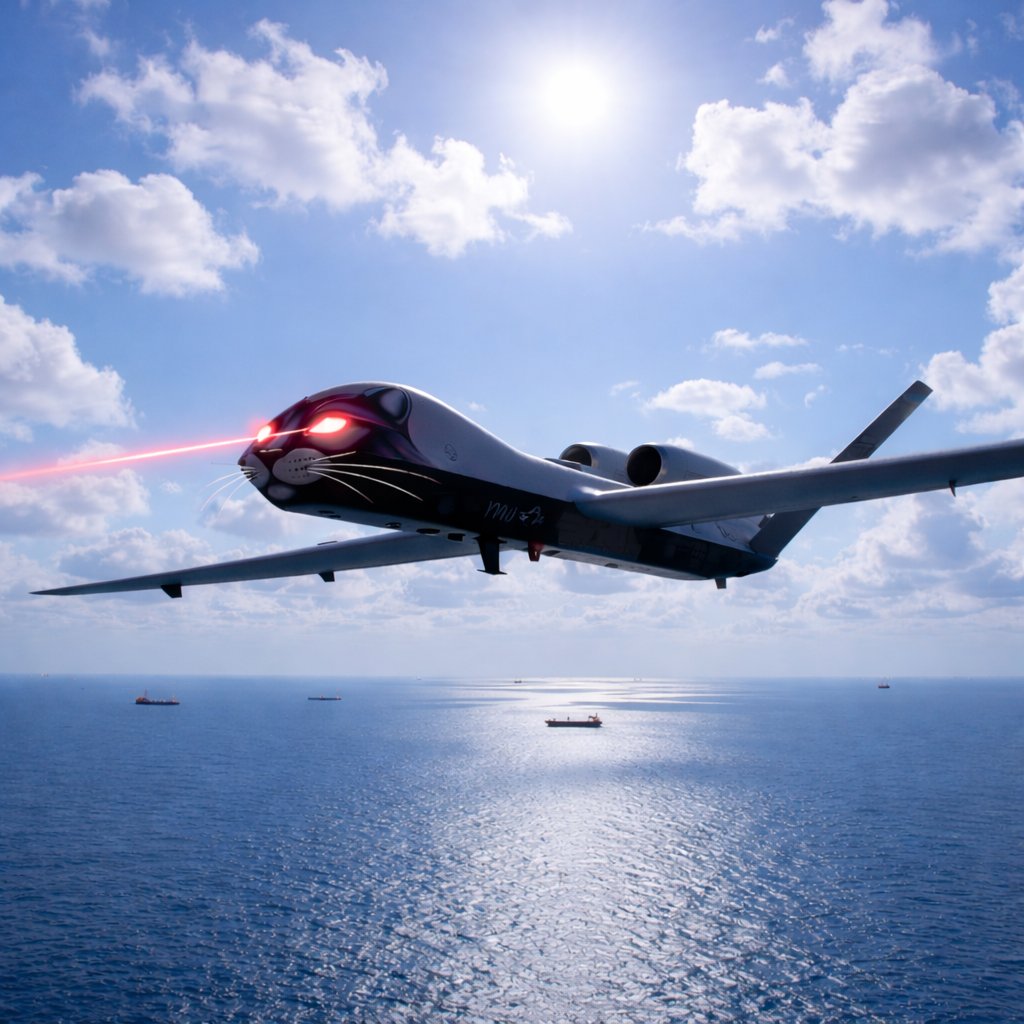
MQ-C Triton
.

The incident occurred on the 9th of this month at 3:42 PM, while it was flying at an altitude of 9,250 feet over the Arabian Gulf between Iran and Saudi Arabia.

The loss of the Triton on April 9th has been recorded in the list of this year’s naval accidents on the official website of the Naval Safety Command (https://navalsafetycommand.navy.mil), the safety and security wing of the U.S. Navy. (See the screenshot of the website page).
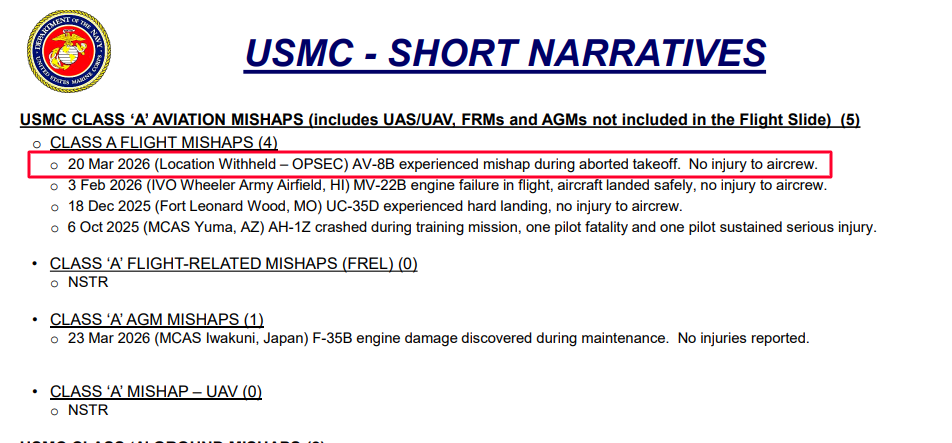
USN Safety page
.

Although the website states that the information regarding the exact crash location is being “withheld,” it is certain that both incidents are one and the same, as it was on April 9th that the aforementioned Triton squawked 7700 (emergency code) and disappeared over the sea while flying at a low altitude. The website also clarifies that no injuries were reported in the crash of this unmanned aerial vehicle (UAV).

Notably, the accident has been categorized as a Class A mishap. This category includes accidents resulting in damages exceeding $2.5 million. The current estimated value of this aircraft is $171.7 million (approximately ₹1,604.3 crore as per current exchange rates).

With this, the aircraft with registration number 169804 becomes the first Northrop Grumman MQ-4C Triton that the United States has officially acknowledged losing in connection with the Middle East conflict.

Additionally, six days before the war began, on February 22nd, another Triton (Registration: 169600) issued a 7700 distress signal during a pre-war surveillance flight and landed at the Al Dhafra Air Base in Abu Dhabi. While it hasn’t been seen since and can be assumed to be completely out of service, there has been no official confirmation regarding that specific case yet.

Timeline of the April 9 crash:

Mission Phase: After completing its surveillance mission at altitudes between 47,000 and 52,000 feet, the drone was heading back toward Sigonella (Italy).
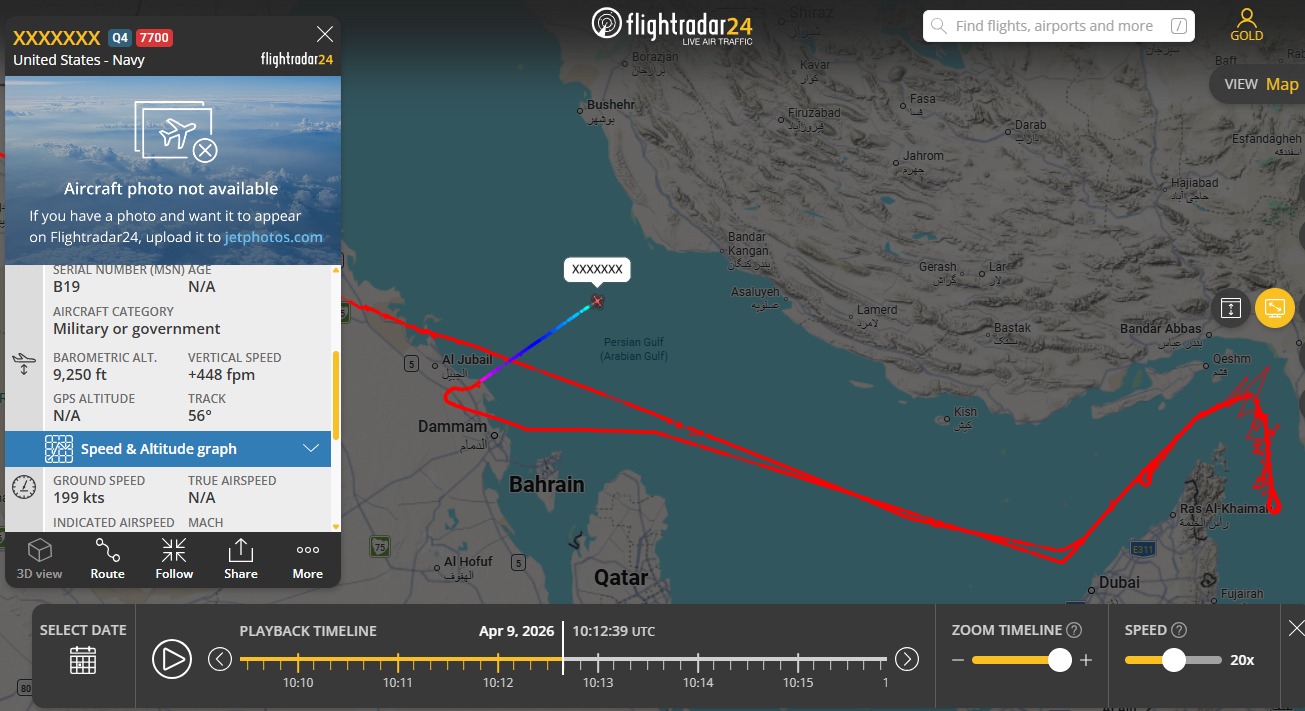
MQ-4C path
.
The Descent: Around 3:26 PM, while flying at 52,000 feet west of Al Ju’aymah (north of Dammam, Saudi Arabia), the aircraft suddenly began to lose altitude.

Final Maneuvers: As it descended, the aircraft performed a U-turn. It only began emitting a distress signal several minutes later, by which time it was over the sea north of Qatar. It briefly headed back toward Saudi Arabia before turning right toward the Iranian coast.

The Disappearance: It finally vanished from radar over the sea after dropping to an altitude of 9,250 feet.

  • Jacob K Philip is the Editor of Aviation India/Indian Aviation News Net. He can be reached at jacob@indianaviationnews.net
Share this:
Share this page via Email Share this page via Stumble Upon Share this page via Digg this Share this page via Facebook Share this page via Twitter

Europe Talks Anti-War — But Its Skies Tell Another Story

By Jacob K Philip

The news that Italy and Spain have imposed restrictions on the passage of planes participating in the US war against Iran, and that Austria has rejected Trump’s demand to open its airspace, has led to the perception that the whole of Europe is gradually turning against the Middle East war.

However, the fact is that there has been no new restriction from Europe that would cause any significant inconvenience to the United States since the war began on February 28. It is just that Switzerland and Austria have never given permission to any country’s warplanes in the past, and they still do not.

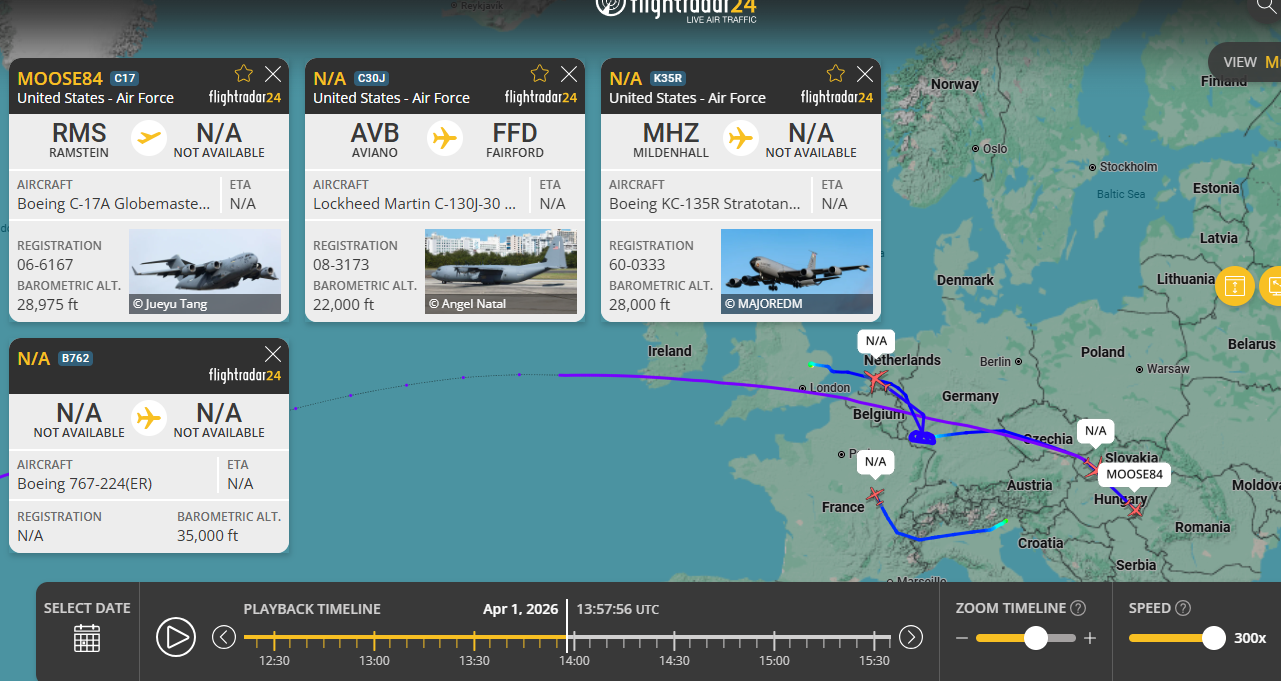
Tankers and transport planes of the USAF flying to and from the Middle East evade Austria, Switzerland

Although Italy and France have recently started saying that they have imposed restrictions, in reality that has not caused any significant disruption to US military aircraft movements.

The skies of the UK, Germany, the Netherlands, Belgium, Denmark, Norway, Portugal, Poland, Romania, Greece, Ireland, Finland and Sweden are still open.

Though the Czech Republic, Slovakia, Hungary, Bulgaria, Croatia and Slovenia say they allow military aircraft to fly over their airspace only under certain conditions, tracking sites show defense aircraft of all hues and colours flying freely through their skies to the Middle East.

Unlike these countries, Austria and Switzerland have very different reasons for keeping fighter jets out.

After World War II, to regain its sovereignty, Austria, which was occupied by the Allies (the US, the Soviet Union, the UK and France), had to agree to the condition that it would remain a neutral, non-aligned country like Switzerland. It is still not a member of NATO and does not allow foreign military bases because of this treaty.

So Austrian leaders could not have allowed US warplanes to fly over their airspace even if they had wanted to.

The neutrality policy of Switzerland, located in the heart of Europe, was decided by the European countries of Austria, Russia, Prussia, the UK and France at the Congress of Vienna in 1815 after the fall of Napoleon. They strictly keep any aircraft involved in the Iranian attack away from their airspace, with the exception of non-war-related transport aircraft, not because the war is not ethical, but to comply with the Vienna Congress.

Just as I had written before, Italy’s recent aversion to US warplanes is nothing more than a drama to satisfy the growing anti-war and anti-Trump sentiment in the country. Planes carrying personnel and supplies to the war still have no difficulty landing at and taking off from Italian air bases through the many loopholes in its regulations.

Although France’s Macron has stated that he does not believe that the Strait of Hormuz can be opened through military action and that he should not heed Trump’s call to join the US in a war against Iran, the fact is that the skies of France, a NATO member, are always open to US military aircraft.

Then there is Spain.

Although Spain has been speaking out against the war in recent times, the fact is that there is still no significant obstacle for US military aircraft to land at the US naval base in Rota and the Morón Air Base and fly to the Middle East. Although it is stated that aircraft carrying weapons and attack aircraft directly related to the war will not be allowed, as in the case of Italy, these policies are also very flexible and can be relaxed if necessary.

Beyond creating an impression that Europe’s skies are not open enough for warplanes to fly, the anti-war statements of the European countries are of not much significance.

Now, the reason why Trump has repeatedly asked Austria to forget about the old treaty and open up the skies:

It is all about money and time.

If Austria, which is located in the middle of the flight path from US military bases in Europe to the Middle East, were to be avoided, it would mean flying 300–500 kilometres more each way. This means that the flight time of military tankers and transport aircraft would be 20–45 minutes longer. In the case of tanker aircraft, this means 2–4 tons more fuel would be burned. And it is not a handful of aircraft that fly along this corridor day and night to the Middle East.

Whatever it is, don’t forget that Trump is ultimately a businessman with a clear sense of profit and loss.

  • Jacob K Philip is the Editor of Aviation India/Indian Aviation News Net. He can be reached at jacob@indianaviationnews.net
Share this:
Share this page via Email Share this page via Stumble Upon Share this page via Digg this Share this page via Facebook Share this page via Twitter

West Asia Conflict: Surprisingly Low Airpower Losses — Or Just the Visible Tip?

By Jacob K Philip

How many military aircraft/remotely controlled aircraft/drones have both sides lost in the West Asia war so far?

While it is true that the first casualty in a war is truth and facts, there are still some figures that can be confirmed as of April 2, a month and three days after the war began.

If we sift through all the information spread by both sides’ news channels, newspapers, and especially social media, it can be seen that the reliable numbers are, five aircraft and 60 remotely controlled aircraft/drones.


.
Aircraft:

1. A US Air Force Boeing KC-135 Stratotanker aircraft.
-Crash on March 12 while flying over western Iraq
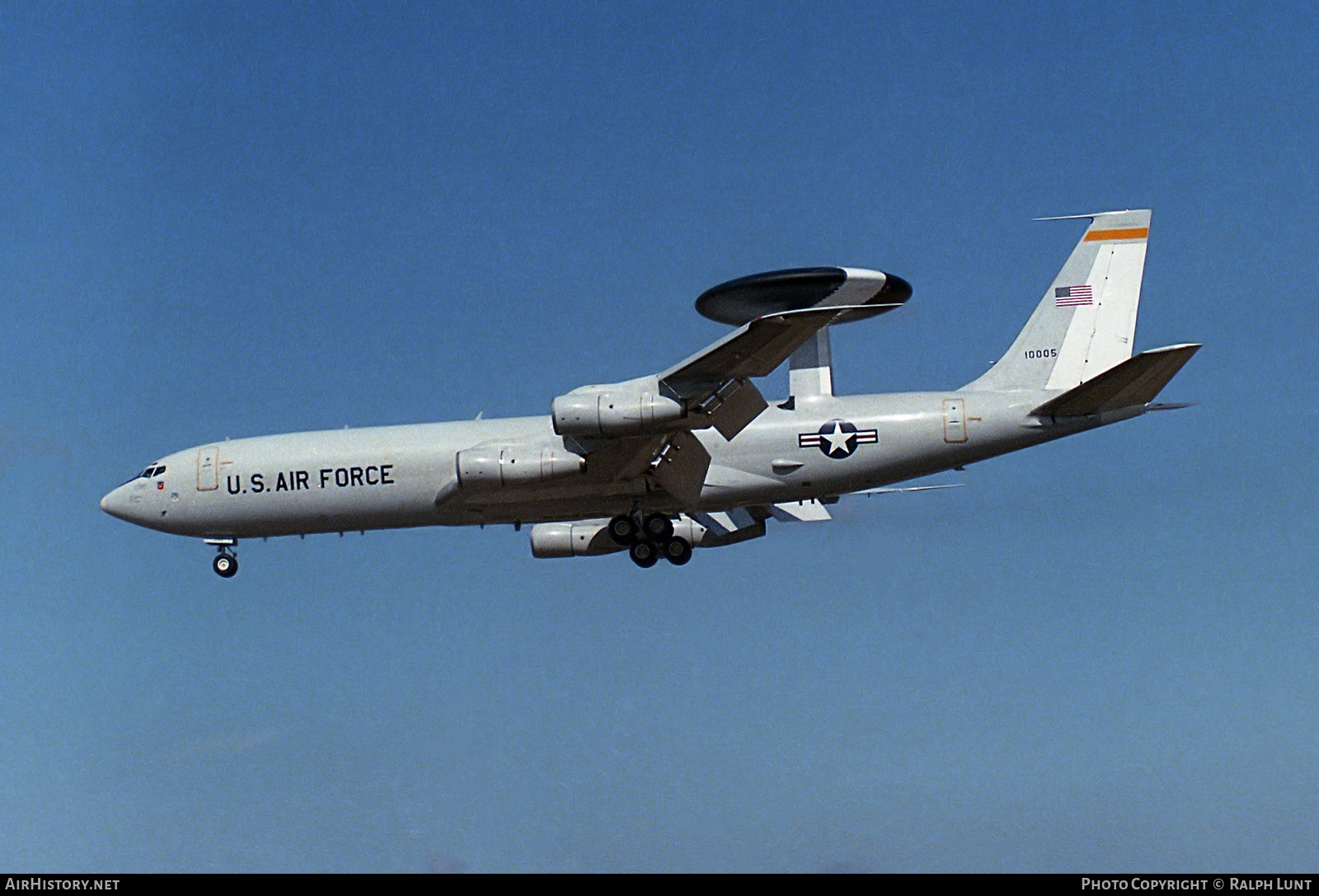
2. A US Air Force Boeing E-3 Sentry AWACS aircraft (registration 81-0005).
-Destroyed by an Iranian missile on March 27 while parked at Prince Sultan Air Base in Al Kharj, Saudi Arabia.
3. Three US Air Force F-15E Strike Eagle fighter jets were accidentally shot down by the Kuwaiti Air Force near Al Jahra, Kuwait, on March 1.

Total 5.

Drones, Remotely Controlled Aircraft:
1. US MQ-9 Reapers – 12
Shot down and damaged during the attack.
2. US MQ-9 UAVs – 5
3. US MQ-4C Triton – 1
This Northrop Grumman MQ-4C remotely piloted-reconnaissance aircraft, registration 169660, has not flown since it made a distress call and landed at Al Dhafra Air Base in Abu Dhabi on February 22.
4. Iranian attack drones (such as the Shaheed) – 40
This is not a complete count. This is because many drones are launched together and many drone interceptions go unrecorded.
5. Israeli Hermes and Heron UAVs – 2
This is also not a complete count. This is because very little information is publicly available about most of Israel’s drones.

A total of 60.

Although the total loss of aircraft and drones has so far been confirmed to be 65, it is widely reported that seven US fighter jets, four AWACS aircraft, three tankers, four transport aircraft and 20 UAVs (such as the MQ-4C Triton) have been destroyed.

These are reasons why these claims cannot be confirmed –

1. No debris from the crashed aircraft have been found anywhere
2. There are no satellite images of the aircraft that are said to have destroyed while parked at airbases.
3. There were no known search and rescue operations after the aircraft went down.
3. There are also no reports of capture of the crew of the aircraft that are claimed to have been shot down, alive or dead.

The mere fact that the aircraft has not been seen on tracking sites does not prove that the aircraft has crashed. During war, such aircraft may fly completely invisible—with their transponders turned off.

There are two reasons why Iran’s losses are not complete.
The first is that Iran has only fielded a few aircraft, just because they have very few fighter planes. And in the present theatre of war, Iranian aircraft do not penetrate and attack enemy areas. Their primary weapons are all missiles and drones. As mentioned earlier, since many drones are launched at once, the number of losses can often be inaccurate.

The reason why Israel’s aircraft losses are not counted is because of the very strict censorship that exists there. Moreover, the fact that the frontline fighters in this war are the United States, is also minimizing and hiding Israel’s air losses.

  • Jacob K Philip is the Editor of Aviation India/Indian Aviation News Net. He can be reached at jacob@indianaviationnews.net
Share this:
Share this page via Email Share this page via Stumble Upon Share this page via Digg this Share this page via Facebook Share this page via Twitter