By Jacob K Philip
The Aircraft Accident Investigation Bureau (AAIB) has published its final investigation report on an incident on the night of October 28, 2022, where an IndiGo flight aborted its takeoff while running down the Delhi airport runway to head to Bengaluru, following an explosion and fire in its right engine.
The report, which provides a detailed explanation of what happened to the engine of the nine-year-old Airbus A320-232 (registration VT-IFM), also raises a few concerns on aviation safety.
On October 28, 2022, the aircraft began its takeoff roll on Runway 28 at Delhi Airport at 9:46 PM. One minute and sixteen seconds later, as it reached a speed of 85 km/h, a sound like an explosion was heard from the right engine, followed by fire and smoke (a pilot of another aircraft on the taxiway called the tower to report seeing flames on the IndiGo plane).
The aircraft also veered to the right during the roll. The pilots immediately deployed the thrust reversers, stopped the aircraft, and shut down the right engine.
Although crash fire tenders dispatched by the tower rushed to the scene, there was only smoke by the time they arrived, likely because the pilots had activated the engine’s onboard fire suppression system. Afterward, the aircraft was moved to a bay using the unaffected left engine, and the passengers were deplaned.
Though there were no injuries to passengers or crew and no damage to the aircraft other than to the right engine, the incident was categorized as a “serious incident,” and the Aircraft Accident Investigation Bureau (AAIB) decided to conduct an investigation.
Reading the report, which is being released now after three years and eight months, one concerning point is the apparent flaws in the systems we assume are in place to resolve defects in critical aircraft components, such as engines, without delay.
The IndiGo A320 involved in the incident was powered by IAE V2527-A5 engines, a joint venture between Pratt & Whitney, Japanese Aero Engine Corporation, and MTU Aero Engines. These engines were manufactured in 2013.
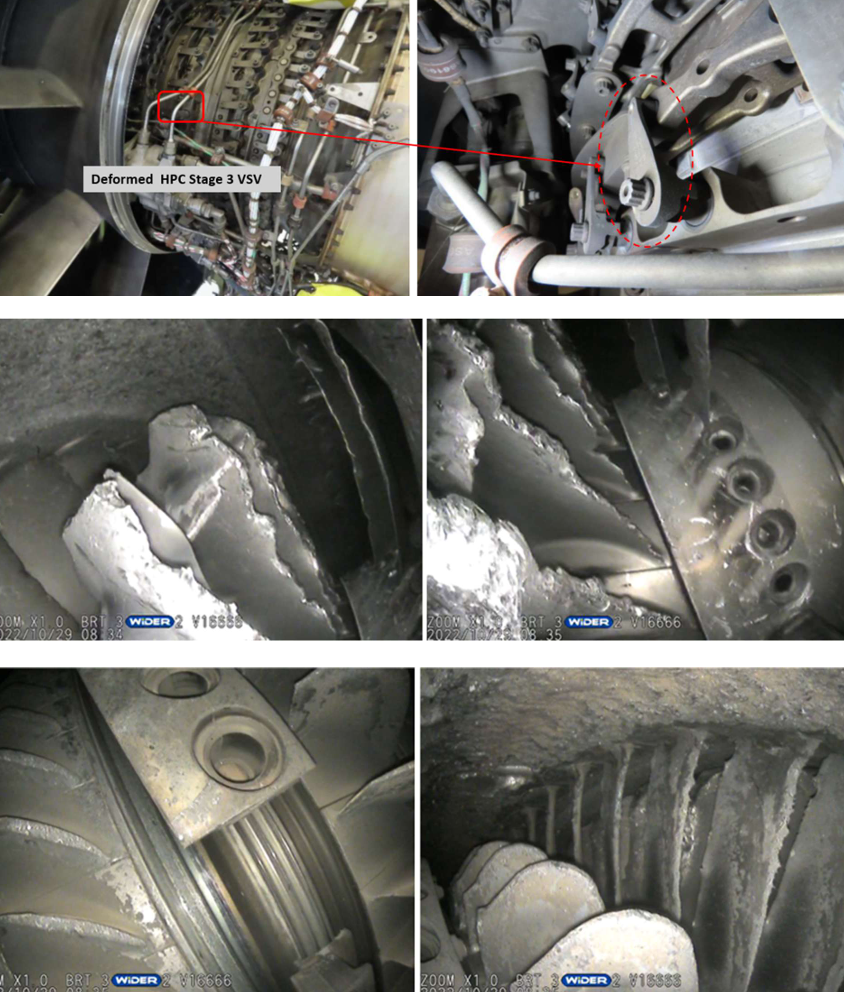
The investigation team, which dismantled and inspected the engine that caught fire and exploded, found that all the titanium alloy high-pressure compressor fan blades—which rotate at high speeds to compress incoming air—had shattered.
Detailed examination clarified the situation. Constant vibration within the engine had caused minor cracks in the first (number 1) high-pressure compressor fan blade at the very front. The excessive vibration of the blades was caused by wear and tear of “clappers,” the small protrusions that are supposed to damp the vibrations by holding or connecting together fan blades. Once the first blade shattered, it collided with the blades behind it in the high-speed airflow, causing them to break as well.
Thus, all 31 blades were destroyed, and metal shards flying around inside the engine caused the explosion sound and the fire.
Though the A320 typically takes off at speeds of 220–270 km/h, at the time of the incident, the aircraft was only at 85 km/h, which is why a major disaster was avoided when the clapper wear worsened and the blades flew off.
Because the low speed, the pilot was able to stop it quickly, shut down the engine, and taxi to the bay.
Now, why did the engine manufacturers not realize that the clappers made of high-strength titanium alloy would suffer wear, leading to increased vibration and blade fractures, and why did they not find a remedy?
The answer is that IAE, the engine manufacturers, were of course aware of these two issues and had attempted to find a solution.
The first attempt was in January 2005. Through a circular, SB V2500-ENG-72-0487, they informed owners of aircraft equipped with these engines that the blades had been redesigned to fix the problem. However, when it was noticed that problems were still occurring in some places, the company issued another circular in 2008—SB V2500-ENG-72-0561.
But that did not solve the problem either. From 2014 to 2022, 57 incidents of such clappers and blades coming loose were reported globally. The IndiGo incident was just one link in that long chain.
In any case, less than two years after the AAIB investigation began, on April 10, 2024, IAE issued another special bulletin—SB V2500-ENG-72-0716. This circular mentions a significant change in how the clappers are painted (coated).
The finding was that if the coating was applied using the High Velocity Oxygen Fuel (HVOF) method instead of the Detonation Gun (D-Gun) method, wear and tear on the clappers could be prevented. It is unclear if there have been engine accidents since engines with these newly coated clappers began to be used.
Reading all this history, one cannot help but think of one thing: the engine in the 2022 IndiGo incident was manufactured about eight years after 2005, when it was noticed that there was a possibility of explosion and fire in aging engines at any time during taxi or flight. In the meantime, there was also a “coating” fix suggested in 2008. Even the latest fix in 2024 came only after 57 such incidents occurred between 2014 and 2022.
How many aircraft of various airlines must have been put at risk by this engine problem during the 19 years from 2005, when the problem was first noticed, until 2024, when the HVOF coating—which is considered to be a largely satisfactory solution—was proposed!
-
Jacob K Philip is the Editor of Aviation India. He can be reached at jacob@indianaviationnews.net