US confirms crash of $171mn ISR UAV over Arabian Gulf

By Jacob K Philip

It is now clear that the US Navy’s Northrop Grumman MQ-4C Triton—a remote-controlled intelligence, surveillance, and reconnaissance (ISR) aircraft—which went missing after issuing a distress signal during a patrol of the Strait of Hormuz, has indeed crashed.

MQ-C Triton
.

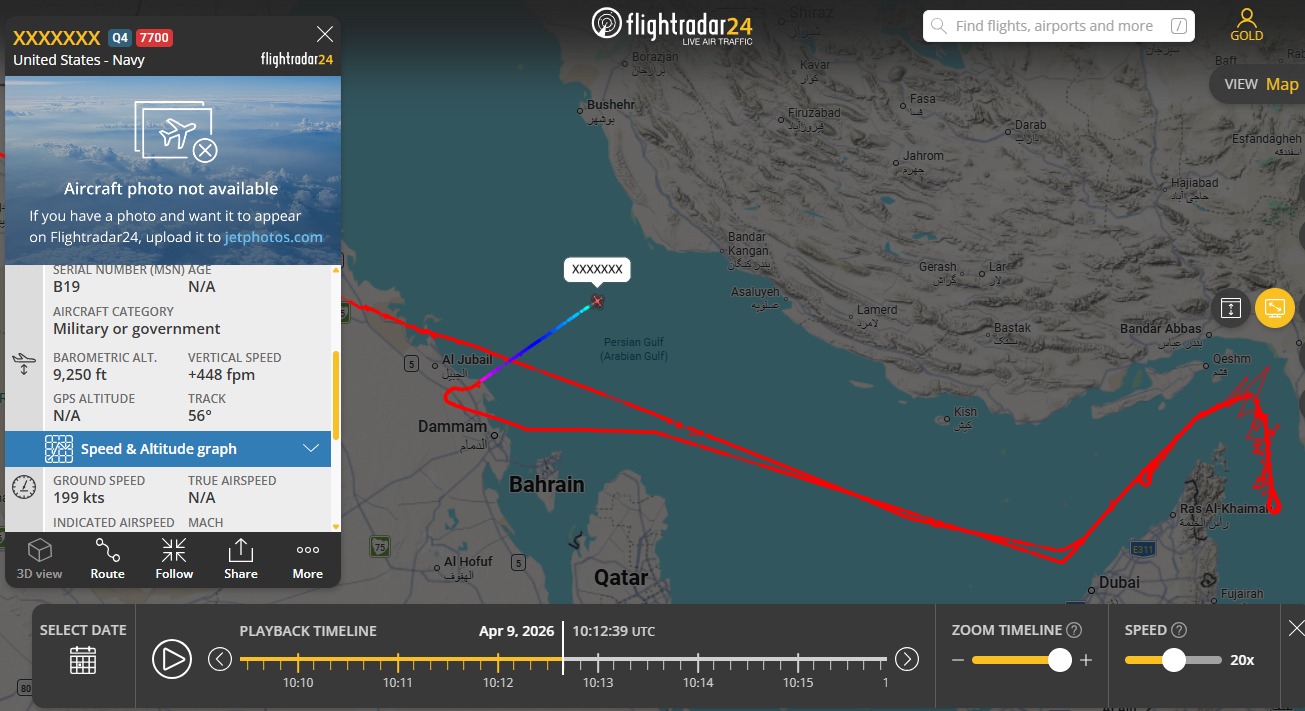
The incident occurred on the 9th of this month at 3:42 PM, while it was flying at an altitude of 9,250 feet over the Arabian Gulf between Iran and Saudi Arabia.

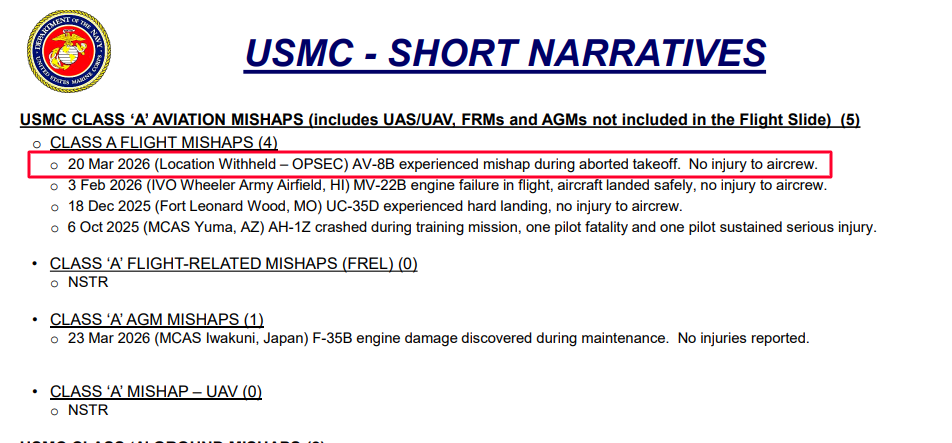
The loss of the Triton on April 9th has been recorded in the list of this year’s naval accidents on the official website of the Naval Safety Command (https://navalsafetycommand.navy.mil), the safety and security wing of the U.S. Navy. (See the screenshot of the website page).

USN Safety page
.

Although the website states that the information regarding the exact crash location is being “withheld,” it is certain that both incidents are one and the same, as it was on April 9th that the aforementioned Triton squawked 7700 (emergency code) and disappeared over the sea while flying at a low altitude. The website also clarifies that no injuries were reported in the crash of this unmanned aerial vehicle (UAV).

Notably, the accident has been categorized as a Class A mishap. This category includes accidents resulting in damages exceeding $2.5 million. The current estimated value of this aircraft is $171.7 million (approximately ₹1,604.3 crore as per current exchange rates).

With this, the aircraft with registration number 169804 becomes the first Northrop Grumman MQ-4C Triton that the United States has officially acknowledged losing in connection with the Middle East conflict.

Additionally, six days before the war began, on February 22nd, another Triton (Registration: 169600) issued a 7700 distress signal during a pre-war surveillance flight and landed at the Al Dhafra Air Base in Abu Dhabi. While it hasn’t been seen since and can be assumed to be completely out of service, there has been no official confirmation regarding that specific case yet.

Timeline of the April 9 crash:

Mission Phase: After completing its surveillance mission at altitudes between 47,000 and 52,000 feet, the drone was heading back toward Sigonella (Italy).
MQ-4C path
.
The Descent: Around 3:26 PM, while flying at 52,000 feet west of Al Ju’aymah (north of Dammam, Saudi Arabia), the aircraft suddenly began to lose altitude.

Final Maneuvers: As it descended, the aircraft performed a U-turn. It only began emitting a distress signal several minutes later, by which time it was over the sea north of Qatar. It briefly headed back toward Saudi Arabia before turning right toward the Iranian coast.

The Disappearance: It finally vanished from radar over the sea after dropping to an altitude of 9,250 feet.

  • Jacob K Philip is the Editor of Aviation India/Indian Aviation News Net. He can be reached at jacob@indianaviationnews.net
Share this:
Share this page via Email Share this page via Stumble Upon Share this page via Digg this Share this page via Facebook Share this page via Twitter

Europe Talks Anti-War — But Its Skies Tell Another Story

By Jacob K Philip

The news that Italy and Spain have imposed restrictions on the passage of planes participating in the US war against Iran, and that Austria has rejected Trump’s demand to open its airspace, has led to the perception that the whole of Europe is gradually turning against the Middle East war.

However, the fact is that there has been no new restriction from Europe that would cause any significant inconvenience to the United States since the war began on February 28. It is just that Switzerland and Austria have never given permission to any country’s warplanes in the past, and they still do not.

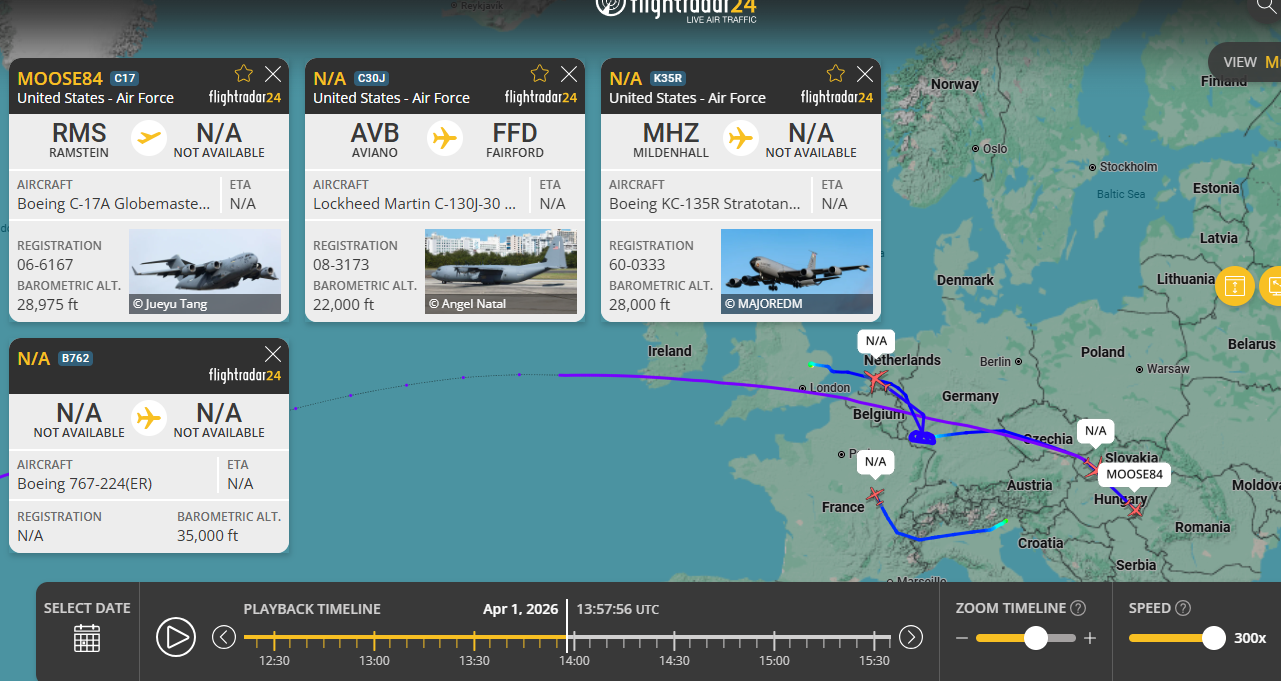
Tankers and transport planes of the USAF flying to and from the Middle East evade Austria, Switzerland

Although Italy and France have recently started saying that they have imposed restrictions, in reality that has not caused any significant disruption to US military aircraft movements.

The skies of the UK, Germany, the Netherlands, Belgium, Denmark, Norway, Portugal, Poland, Romania, Greece, Ireland, Finland and Sweden are still open.

Though the Czech Republic, Slovakia, Hungary, Bulgaria, Croatia and Slovenia say they allow military aircraft to fly over their airspace only under certain conditions, tracking sites show defense aircraft of all hues and colours flying freely through their skies to the Middle East.

Unlike these countries, Austria and Switzerland have very different reasons for keeping fighter jets out.

After World War II, to regain its sovereignty, Austria, which was occupied by the Allies (the US, the Soviet Union, the UK and France), had to agree to the condition that it would remain a neutral, non-aligned country like Switzerland. It is still not a member of NATO and does not allow foreign military bases because of this treaty.

So Austrian leaders could not have allowed US warplanes to fly over their airspace even if they had wanted to.

The neutrality policy of Switzerland, located in the heart of Europe, was decided by the European countries of Austria, Russia, Prussia, the UK and France at the Congress of Vienna in 1815 after the fall of Napoleon. They strictly keep any aircraft involved in the Iranian attack away from their airspace, with the exception of non-war-related transport aircraft, not because the war is not ethical, but to comply with the Vienna Congress.

Just as I had written before, Italy’s recent aversion to US warplanes is nothing more than a drama to satisfy the growing anti-war and anti-Trump sentiment in the country. Planes carrying personnel and supplies to the war still have no difficulty landing at and taking off from Italian air bases through the many loopholes in its regulations.

Although France’s Macron has stated that he does not believe that the Strait of Hormuz can be opened through military action and that he should not heed Trump’s call to join the US in a war against Iran, the fact is that the skies of France, a NATO member, are always open to US military aircraft.

Then there is Spain.

Although Spain has been speaking out against the war in recent times, the fact is that there is still no significant obstacle for US military aircraft to land at the US naval base in Rota and the Morón Air Base and fly to the Middle East. Although it is stated that aircraft carrying weapons and attack aircraft directly related to the war will not be allowed, as in the case of Italy, these policies are also very flexible and can be relaxed if necessary.

Beyond creating an impression that Europe’s skies are not open enough for warplanes to fly, the anti-war statements of the European countries are of not much significance.

Now, the reason why Trump has repeatedly asked Austria to forget about the old treaty and open up the skies:

It is all about money and time.

If Austria, which is located in the middle of the flight path from US military bases in Europe to the Middle East, were to be avoided, it would mean flying 300–500 kilometres more each way. This means that the flight time of military tankers and transport aircraft would be 20–45 minutes longer. In the case of tanker aircraft, this means 2–4 tons more fuel would be burned. And it is not a handful of aircraft that fly along this corridor day and night to the Middle East.

Whatever it is, don’t forget that Trump is ultimately a businessman with a clear sense of profit and loss.

  • Jacob K Philip is the Editor of Aviation India/Indian Aviation News Net. He can be reached at jacob@indianaviationnews.net
Share this:
Share this page via Email Share this page via Stumble Upon Share this page via Digg this Share this page via Facebook Share this page via Twitter

West Asia Conflict: Surprisingly Low Airpower Losses — Or Just the Visible Tip?

By Jacob K Philip

How many military aircraft/remotely controlled aircraft/drones have both sides lost in the West Asia war so far?

While it is true that the first casualty in a war is truth and facts, there are still some figures that can be confirmed as of April 2, a month and three days after the war began.

If we sift through all the information spread by both sides’ news channels, newspapers, and especially social media, it can be seen that the reliable numbers are, five aircraft and 60 remotely controlled aircraft/drones.


.
Aircraft:

1. A US Air Force Boeing KC-135 Stratotanker aircraft.
-Crash on March 12 while flying over western Iraq
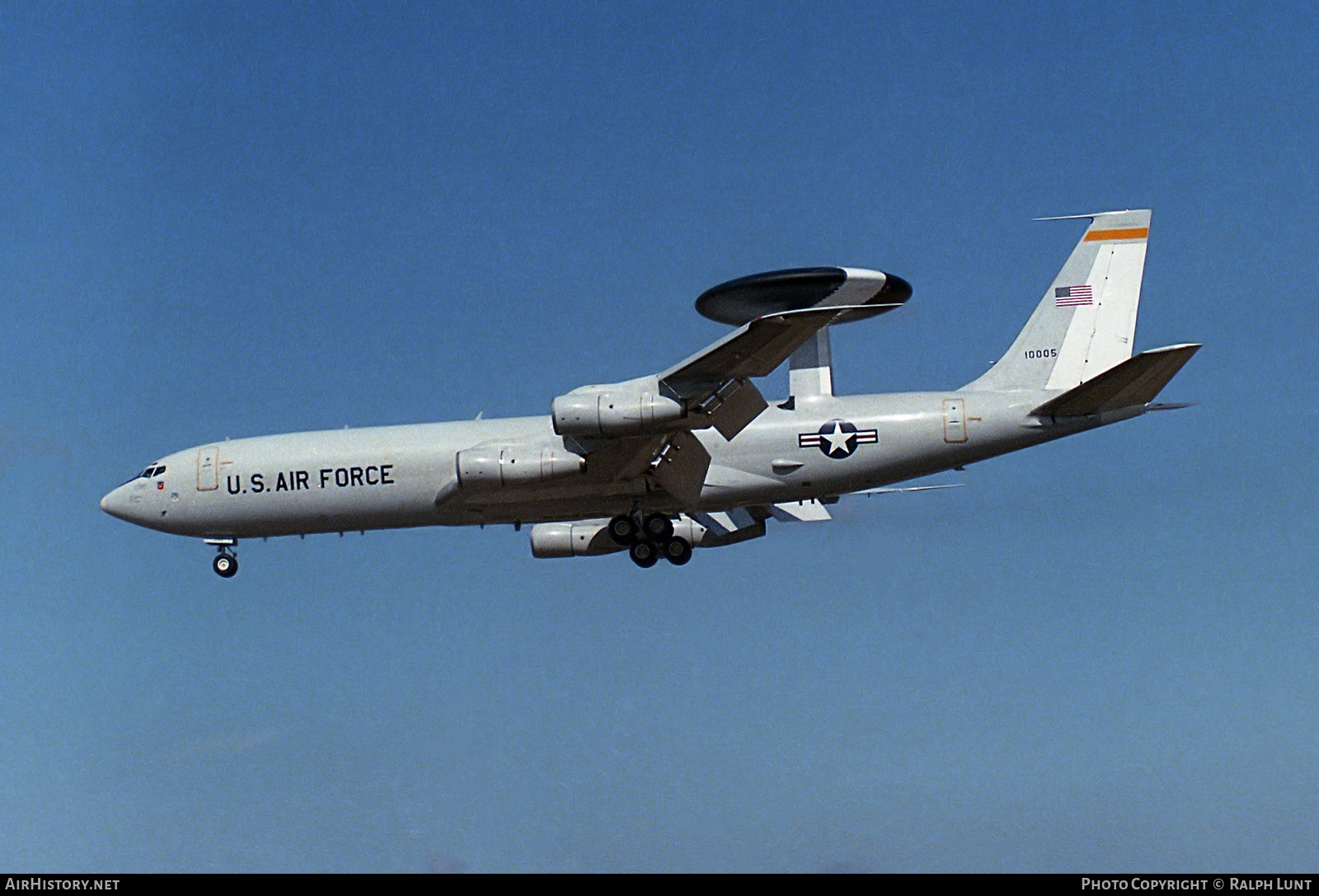
2. A US Air Force Boeing E-3 Sentry AWACS aircraft (registration 81-0005).
-Destroyed by an Iranian missile on March 27 while parked at Prince Sultan Air Base in Al Kharj, Saudi Arabia.
3. Three US Air Force F-15E Strike Eagle fighter jets were accidentally shot down by the Kuwaiti Air Force near Al Jahra, Kuwait, on March 1.

Total 5.

Drones, Remotely Controlled Aircraft:
1. US MQ-9 Reapers – 12
Shot down and damaged during the attack.
2. US MQ-9 UAVs – 5
3. US MQ-4C Triton – 1
This Northrop Grumman MQ-4C remotely piloted-reconnaissance aircraft, registration 169660, has not flown since it made a distress call and landed at Al Dhafra Air Base in Abu Dhabi on February 22.
4. Iranian attack drones (such as the Shaheed) – 40
This is not a complete count. This is because many drones are launched together and many drone interceptions go unrecorded.
5. Israeli Hermes and Heron UAVs – 2
This is also not a complete count. This is because very little information is publicly available about most of Israel’s drones.

A total of 60.

Although the total loss of aircraft and drones has so far been confirmed to be 65, it is widely reported that seven US fighter jets, four AWACS aircraft, three tankers, four transport aircraft and 20 UAVs (such as the MQ-4C Triton) have been destroyed.

These are reasons why these claims cannot be confirmed –

1. No debris from the crashed aircraft have been found anywhere
2. There are no satellite images of the aircraft that are said to have destroyed while parked at airbases.
3. There were no known search and rescue operations after the aircraft went down.
3. There are also no reports of capture of the crew of the aircraft that are claimed to have been shot down, alive or dead.

The mere fact that the aircraft has not been seen on tracking sites does not prove that the aircraft has crashed. During war, such aircraft may fly completely invisible—with their transponders turned off.

There are two reasons why Iran’s losses are not complete.
The first is that Iran has only fielded a few aircraft, just because they have very few fighter planes. And in the present theatre of war, Iranian aircraft do not penetrate and attack enemy areas. Their primary weapons are all missiles and drones. As mentioned earlier, since many drones are launched at once, the number of losses can often be inaccurate.

The reason why Israel’s aircraft losses are not counted is because of the very strict censorship that exists there. Moreover, the fact that the frontline fighters in this war are the United States, is also minimizing and hiding Israel’s air losses.

  • Jacob K Philip is the Editor of Aviation India/Indian Aviation News Net. He can be reached at jacob@indianaviationnews.net
Share this:
Share this page via Email Share this page via Stumble Upon Share this page via Digg this Share this page via Facebook Share this page via Twitter

Who Started the 2026 Iran War? What Tanker Planes Reveal

By Jacob K Philip

The movements of US Air Force planes in January and February suggest that the United States had not decided when to go to war—or maybe even whether to go to war—with Iran until the day before the attack, and that it was Israel that unilaterally launched the attack on February 28.

It is the Boeing KC-135R Stratotanker aircraft, which refuel fighter jets mid-air, that returned to the United States in two batches in January and February from the US military base at Al Udeid, Qatar, that provide this insight into how the war began.

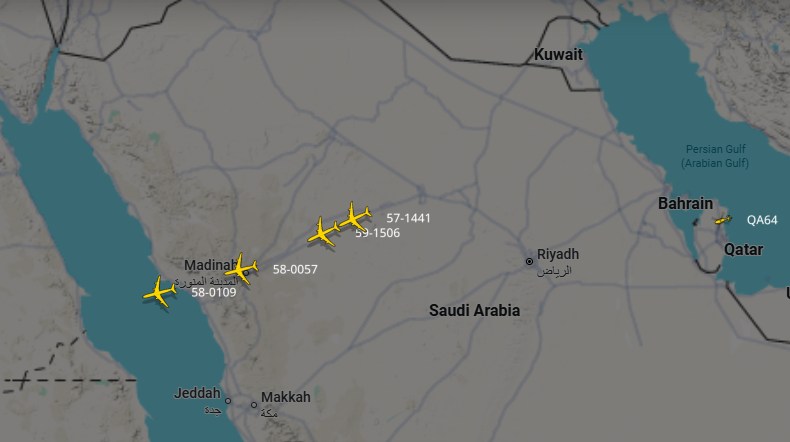
Tankers returning to the US from Al Udeid base, Qatar, on January 24.

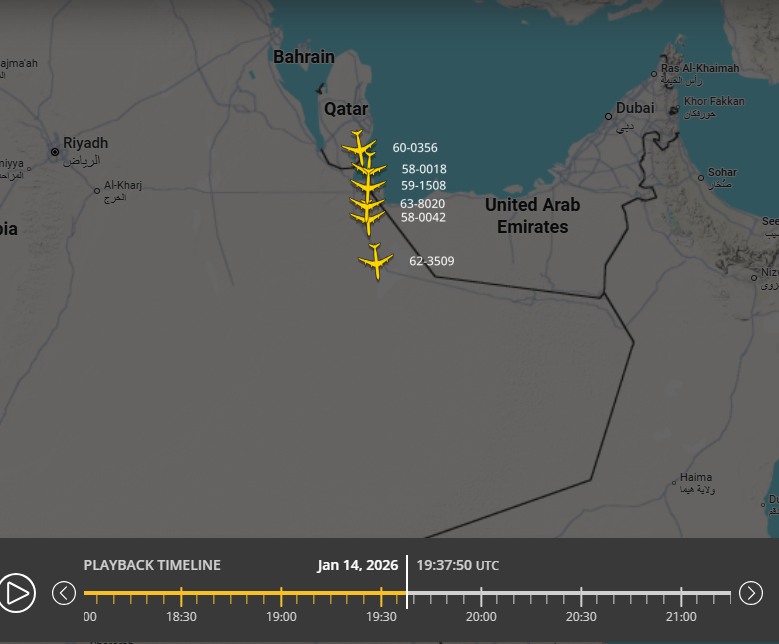
Flight-tracking sites show that four tankers with registration numbers 58-0109, 58-0057, 59-1506 and 57-1441 flew back to various US bases from the Al Udeid military base in Qatar on January 24, and five tankers with registration numbers 60-0356, 58-0018, 58-0042, 59-1508 and 63-8020 returned on February 10.


The tankers that appeared to be moving out of Al Udeid US base in Qatar on Janury 14. Of these five tankers returned to US during February 9, shows Flightradar24. 

Note the dates January 24 and February 10.

As the threat of war grew stronger by the day, Trump said on January 23 that he hoped military action would not be necessary against Iran.

The first batch of tankers returned to the US the next day.

The UAE, Saudi Arabia, Qatar, Egypt, Jordan, Turkey, Indonesia and Pakistan jointly called on February 9 for the conflict not to escalate and for war to be avoided.

The next day, February 10, five more tankers returned to the United States.

It is clear that, because the United States had not decided conclusively in favour of war despite the increasing tension in West Asia, the fuel tankers—indispensable for air warfare—were sent back to their home bases 11,000 kilometres away.

Although things were becoming more complicated even as the second batch of tanker planes were flying back to the United States, there was still no sign that the United States had reached a final decision to go to war.

The mediator, Oman, was also saying that things were progressing smoothly.

While rapid military moves continued, by February 16 Trump had said that the US would retaliate if Iran attacked. But the second round of Iran-US talks in Geneva on the 17th ended with a decision to prepare guidelines for further talks.

The third round of talks was held on the 26th in Switzerland at the residence of the Omani ambassador to the UN. After the talks, Iran announced that it would not stockpile enriched uranium and would allow IAEA inspections. Later, the Omani foreign minister said that good news might be available soon.

The next day, on February 27, although Trump said he was not happy with the position taken by Iran in the talks and that military action remained an option, he stopped short of saying that a final decision on war had been made.

However, 24 hours later, on February 28, Iran was attacked without warning.

Some believe the US was preparing for the February 28 attack while creating the impression that it was not, by hiding most of its war preparations and by participating in the nuclear talks.

That was quite possible, given the history of deception and wartime tactics associated with both Israel and the United States.

However, the trajectory of the tankers in question during these days paints a different picture.

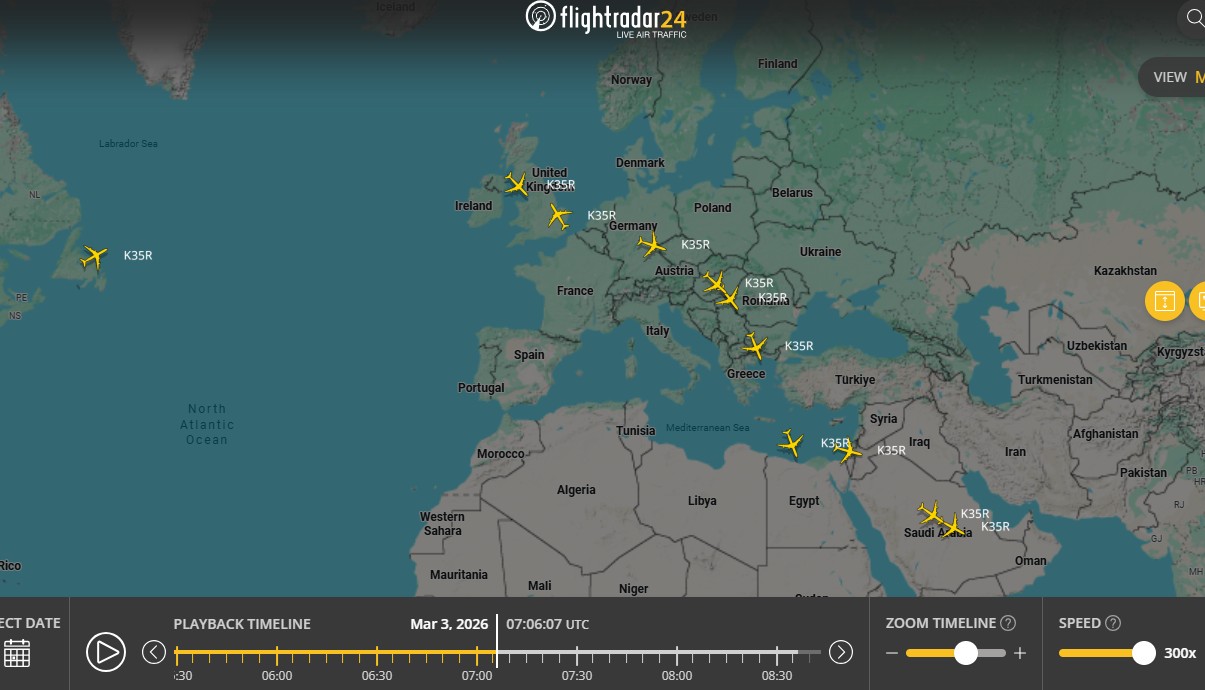
After the en masse return of tanker planes to the US on January 24 and February 10, they appeared to be returning to West Asia only hours after the war began, that is, during early morning of February 29.

The return of tanker convoys continued until March 3.

Tanker planes coming back to West Asia early morning of February 29.
Tanker planes returning to West Asia on March 3.

If the intention had been to mislead Iran into believing there would be no war, there would have been no need for the tankers to fly all the way back to the US. After flying out of the Middle East with their transponders on, they could simply have returned to US bases in the Gulf in invisible mode (after turning off their transponders).

Remember that these planes never returned to West Asia before the war, even though the talks mediated by Oman, which lasted until February 27, were oscillating between failure and success.

The fact that the return flights began only hours after the attack indicates that the war that started on the morning of February 28 was unexpected for the United States.

There is another reason to believe that Israel pushed the hesitant United States into the war by carrying out the first attack, which killed Iran’s Supreme Leader, Ayatollah Ali Khamenei.

Eliminating the leadership of the attacked country at the very beginning of a war is considered a distinctive Israeli strategy.

And the F-35I Adir, a stealth fighter jet that many defence experts believe was used in the attack, is operated not by the United States but by Israel.

This aircraft is capable of conducting long-range attack missions without the need for in-flight refuelling. If refuelling was needed at all, Israel had Boeing 707 Re’em tankers. In other words, they did not have to rely on American Stratotankers.

Two hours after the first attack that killed Khamenei and other leaders, the Minab school attack—which killed 180 people, mostly girls—took place, marking the entry of the United States into the war that had been started by Israel.

  • Jacob K Philip is a Kochi based aviation analyst and honorary editor of Aviation India. He can be reached at jacob@indianaviationnews.net
Share this:
Share this page via Email Share this page via Stumble Upon Share this page via Digg this Share this page via Facebook Share this page via Twitter

Pilot error caused crash of LuLu Group MD’s copter in Kerala: DGCA report

By Jacob K Philip

A chain of unusual and erroneous actions taken by the pilots caused the crash of a helicopter last year in India that was carrying M. A. Yousuf Ali, the chairman of UAE-headquartered multinational company Lulu Group, says the report of an investigation ordered by the DGCA, India’s aviation regulator.

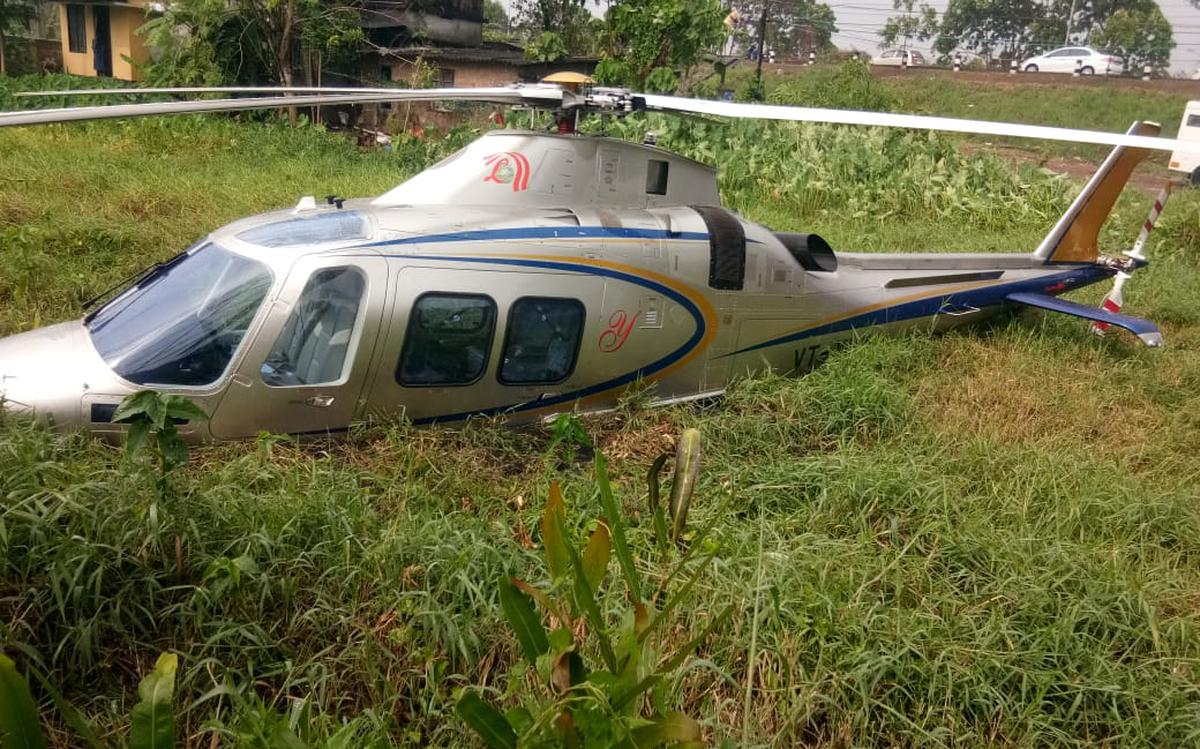
Unlike the media widely reported that time, the three year old Agusta Westland AW109SP helicopter was not making an emergency landing but was actually falling into a swamp at Panangadu, near Kochi, in the south Indian state of Kerala, as per the investigation report.

The incident occurred on April 11, 2021 a few minutes before 9am at Panangadu. The copter, that had taken-off from a helipad at ‘Y Mansion”, the residence of Yousuf Ali, was heading to land on the roof-top helipad of ‘Lakeshore’, a private hospital. The aerial distance to the hospital from Yousuf Ali’s residence was just 3.7km and the total flying time was estimated to be 5 minutes. While the copter was in the approach stage to land on the Lakeshore helipad, it fell into the open swamp from a height of about 300ft. Upon falling, the helicopter partially sunk into the soft mud, with dirt water entering the cockpit by up to 2 feet. Engines were shut down and all the occupants vacated the helicopter by standard exit and were transported to nearby hospital. There was no injury to any of the occupants on board, and there was no post incident smoke or fire.

VT-YMA after the crash
The helicopter after the crash.

Though the pilots later said they had made a forced landing due to loss of engine power after experiencing a sudden drop in altitude, the DGCA report says there were nothing wrong with any of the systems of the helicopter including the engine. Also, the pilots had made no landing – forced or otherwise.

It was a series of actions by the pilots right from the taking off of the machine, that culminated in the crash that April morning, concludes the report.

To start with, when the helicopter took of from the ‘Y Mansion’,  at Chilavannoor, Kochi, the pilots activated ‘Engine torque limiter function’ of the copter. This function limits the torque (power) produced by the engine to 220 % instead of its maximum capability of 324%. Why this limit was set is not clear.

Secondly, when it was time for the copter to take a left turn to align with the roof-top helipad of the Lakeshore hospital, the pilot increased the pitch of the craft (raised the nose) to an unusual high value of about 15 degrees. Though with the nose up, the engines needed more power to maintain the speed, that was never given. As a result the speed was reduced to 40 kts from 80kts and the copter began to descend rapidly. Three seconds after the pitch was increased to 15, it again was raised to 21 degrees, again unusually, by the pilot. As a result the the fall became quicker at 2000ft/minute and the horizontal speed became almost zero. On realizing the craft was falling, the pilots tried to increase the engine power, so as to climb up. But because of the ‘Engine torque limiter function’ they had earlier switched on, the fuel supply to the engine got reduced after the power reached the 220%. Less fuel means less power and the pilots could not climb up from the 300ft altitude there found themselves in and the helicopter fell to the ground within seconds.

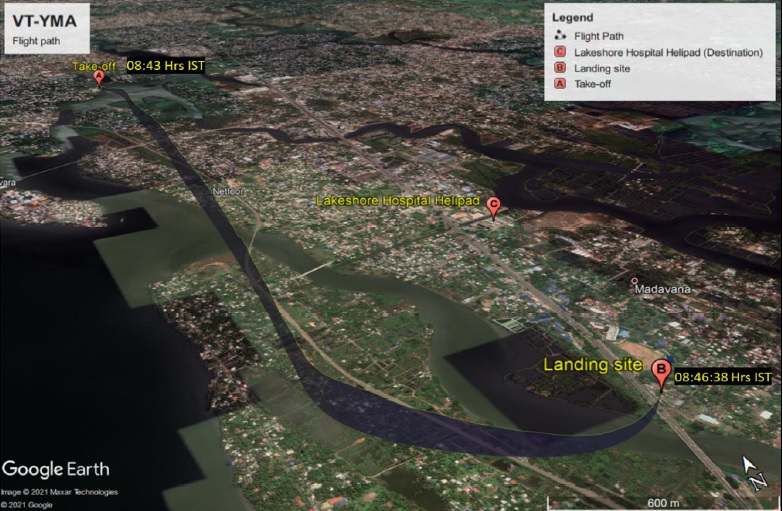
flight path- VT YMA
The flight path of the helicopter – Reproduced from the DGCA report

The report explains that, because of the actions of setting a limit to the engine power and then increasing the pitch attitude, the helicopter also had entered into a non-recoverable stage called ‘Vortex Ring State (VRS).’ With VRS setting in, the lift produced by the rotor is massively reduced and the rate of descent of the helicopter is increased accordingly. By pulling on the collective, the effect is amplified. The VRS can be ended only by switching to autorotation or by taking up horizontal speed. But at Panangad that morning, the speed was actually getting reduced to half of the normal speed, seconds before the crash.

The DGCA report concludes that the erroneous actions taken by the pilots resulted in the crash was also because of the loss of situational awareness and not sticking to the standard operational procedures.

While examining the cockpit voice recorder, the investigators found that the voices in the cockpit were overlapped by the conversations among the passengers in the cabin. It was because the cockpit was not isolated from the cabin, even during the critical stages of the flight. The reason why the pilots lost the situational awareness can be these distractions from the cabin. Though the well experienced pilots were familiar with the short route, they failed to realise for some seconds that the copter was flying too low. Also, the first Officer (who was acting as the ‘pilot monitoring’) failed to monitor flight parameters during the critical phase of flight. It was only when the copter reached the altitude as low as 300ft, that pilot in command realised the gravity of the situation. Though he immediately increased the power to go up, because their own previous action of switching the ‘Engine torque limiter function’ on, the power refused to go up after it reached 220% and the fuel supply to the engine too got reduced. The rotor speed was dropped because of this and even the the automated warning ‘ROTOR LOW’ was sounded. By then the copter had got entangled in the irrecoverable Vortex Ring State and there was nothing that could have done but to braze for the crash.
And the helicopter at that moment happened to be above a marshy land was just providential. Otherwise the crash would have been real disastrous.
The investigators also have pointed out that the pilots in this flight (and in their previous flights too) were carrying out cockpit checks communicating with ‘gestures’. Because the procedure of ‘challenge and response’ was not carried out as per the SOP, the chances are high that crucial parameters of the flight was overlooked.

Share this:
Share this page via Email Share this page via Stumble Upon Share this page via Digg this Share this page via Facebook Share this page via Twitter

Diminishing Returns: Calculated Misery in Air Travel

Dr. Binoy Kampmark

If there comes a point when people will decide not to fly, the issue may well be less to do with any moral or ethical issue with climate change than the fact that commercial flights have become atrocious. They are naked money-making concerns with diminishing returns on quality. The key factor that plays out here is what economists like to term inelastic demand. Prices can be raised; service quality can be reduced, but customers will keep coming. The demand remains, even if the supply leaves much to be desired.

The phenomenon is distinct over the long-haul carriers, which have, at least until recently, been spared the stripping phenomenon. Singapore Airlines, which prides itself for an almost aristocratic bearing towards its customers, proved skimp its Melbourne to Singapore leg. An insulting sampling of “toasties” was offered as a starter, a culinary outrage that did not go unnoticed. Indian passengers who had selected special meals in advance were on the money; pungent curries and dhal filled the cabin as this ridiculous excuse of a meal was handed out to customers. A few desperate, and disgusted punters asked the flight attendants if there were spare vegetarian options.

Budget airlines may have something to explain in this regard. The revolution of the cheap fare came with the reduction of expectations. No frills travel came with a certain contempt on the part of the service providers: food and drink would no longer be gratis; seat allocations would have to be purchased in advance and check-in or carry-on luggage would have to be paid for. A turning point was Dublin-based Ryanair’s attempt to go easy on toilet numbers – one per aircraft – and charge customers for their use. As the company’s penny-pinching CEO Michael O’Leary said at the time, “We rarely use all three toilets on board our aircraft anyway.” Bladders be damned.

Instead of aspiring to a higher level of service, the traditionalists have voted to go down a notch or three. What budget airlines do badly, we can do worse. The law of diminishing returns is pushing all air travel carriers downwards in what has been seen to be an exercise of “calculated misery”. The experience is appalling and unpleasant, but need not necessarily be intolerable. The result is a curious revision of the term “upgrade”. As Alex Abad-Santos laments in Vox, passengers upgrade their seats, not to get a more spectacular service or experience, but “to avoid hell.”

Managing such misery is hardly original, though Tim Wu of Columbia Law School can be credited for giving a good overview of it when writing in 2014 for The New Yorker. “Here’s the thing: in order for fees to work, there needs to be something worth paying to avoid. That necessitates, at some level, a strategy that can be described as ‘calculated misery’. Basic service, without fees, must be sufficiently degraded in order to make people want to pay to escape it. And that’s where the suffering begins.”

Nothing says such suffering than crammed economy seats on a long-haul flight. Shoulders and arms are jammed; legs can barely move. The trend was such that Bill McGee, a writer with more than a passing acquaintance with the airline industry, would note, referring to the United States, that the most spacious economy seats “you can book on the nation’s four largest airlines are narrower than the tightest economy seats offered in the 1990s.”

Things are not much better in terms of the European market. Mediocrity mixes with indifference, even on flights which are half-full. A flight from London Heathrow to Copenhagen with Scandinavian Airlines was characterised by a certain snooty indifference on the part of the flight attendants. Much babbling was taking place in Finnish – why would you want to assist passengers? Little by way of interest in the customers was afforded. Curt instructions were issued; requests for coffee were received with glacial stares. Naturally, to receive a meal and drink that wasn’t water that had seen better days required forking out of the plastic fantastic. Gone are the days when international airlines behaved as such, wishing to make matters decent, comfortable and even pleasantly bearable; the European air space finds itself populated by the stingy and the tight-belted.

Commercial airlines from SAS to Singapore Airlines have taken whole sheafs of extortion from the budget airline book of making customers pay for selecting seats. The stress here is budget service at caviar prices. This cheeky form of thieving imposes a cost on the act of jumping the queue for a better place on the flight. And this is not all. You book a ticket with a flight, only to find at the airport that you had purchased a “light” version, meaning that you have to pay for carryon luggage.

High time for a customer revolt, but the industry is distinctly programmed. Even when airlines have been well disposed to their customers, such as JetBlue, the corporate monsters of Wall Street have howled. It’s bad form to provide decent service within reasonable expectations. Efficiency, and filling the seats, is what matters, whatever the quality. Fee-free services, being conscious of the brand and a “customer-focussed” approach was simply not on. Eventually, JetBlue caved in and joined the market of calculated misery.

 Dr. Binoy Kampmark was a Commonwealth Scholar at Selwyn College, Cambridge. He lectures at RMIT University, Melbourne. Email: bkampmark@gmail.com
Share this:
Share this page via Email Share this page via Stumble Upon Share this page via Digg this Share this page via Facebook Share this page via Twitter

Airports’ privatization: CIAL not qualified to bid for Trivandrum

By Jacob K Philip

The move to privatize the second batch of airports in India has evoked varying responses from the public and the stake holders. Though it seems the Airports Authority of India (AAI) top brass is all for it, the staff of the Mini Ratna company have made it pretty clear that they are dead against selling out the profitable airports and are already in the warpath.
But the most interesting response seems to be that of the Government of Kerala. To prevent the Thiruvananthapuram International Airport ending up in private hands, the govt has decided to take an extraordinary step – to participate in the competitive bidding to run the airport.
Reports are already allover the media that the Government has authorized Cochin International Airports Ltd (CIAL), the company that had set up and runs the Kochi International Airport in PPP mode, to bid for the right to run the state capital airport. And quoting state government officials and CIAL staff, the media reports assert that CIAL qualifies to bid, as per the criteria enlisted in the Request for Proposal (RFP) released by AAI.

But a careful study of the RFP makes it abundantly clear that CIAL does not have the PQs (Pre-Qualifications), at least for the time being.

Here is why:

Though all the media reports say CIAL qualifies, because the company has the minimum net-worth stipulated in the RFP, that is Rs 10,000 million (1000 crore), there still is one more PQ to meet.

See how the RFP describes this “Technical Qualification” (One may wonder why AAI preferred to call it technical when it too is all about finance):

For demonstrating technical capacity and experience (“Technical Capacity”), the Bidder shall over the past 7 (seven) financial years preceding the Bid Due Date have:
(i) paid for, or received payments for, construction of Eligible Projects; and/or
(ii) paid for development of Eligible Project(s); and/or
(iii) collected and appropriated revenues from Eligible Project(s),

such that the above amount is equal to or more than:
(i) 100% (one hundred percent) of Rs. 3500,00,00,000 (Rupees Three Thousand Five Hundred Crore) in case of 1 (one) Eligible Project; or
(ii) 50% (fifty percent) of Rs. 3500,00,00,000 (Rupees Three Thousand Five Hundred Crore) in case of 2 (two) Eligible Projects; or
(iii) 40% (forty percent) of Rs. 3500,00,00,000 (Rupees Three Thousand Five Hundred Crore) in case of 3 (three) Eligible Projects.

This means, for CIAL to qualify, the total revenue they have collected from the airport business during the past seven years must be more than or equal to 35000 million (3500 crores) Rupees.

But CIAL could earn only Rs. 2923.03 crores during this period, as per their annual reports:

  • 2017-18    553.42
  • 2016-17    487.28
  • 2015-16    524.53
  • 2014-15    413.96
  • 2013-14    361.39
  • 2012-13   306.50
  • 2011-12    275.95

But there still was a way out.

CIAL has five subsidiary companies in which it has 99% share holding. They can very well apply together. These are the companies:

  1. Cochin International Aviation Services Ltd
  2. CIAL infrastructure Ltd
  3.  Air Kerala International Services Ltd
  4. CIAL Dutyfree and Retail Services Ltd
  5. Kerala waterways and Infrastructure Ltd

Of these, only 1, 2 and 4 generate income.

CIAL’s annual reports give the combined income of CIAL and these 3 companies for the past four years. (It seems those companies generated nil or negligible revenue before that period) .

So the revised figures for seven years look like this:

  • 2017-18    701.13
  • 2016-17    592.65
  • 2015-16    539.38
  • 2014-15    423.53
  • 2013-14   361.39
  • 2012-13   306.50
  • 2011-12   275.95

Now the total is 3200.53 crores – but still Rs.299.47 crore less than the required magical figure of 3500 crores.

But even if the amount had reached 3500, there still was another obstacle.

Read this clause:

(i) 100% (one hundred percent) of Rs. 3500,00,00,000 (Rupees Three Thousand Five Hundred Crore) in case of 1 (one) Eligible Project; or
(ii) 50% (fifty percent) of Rs. 3500,00,00,000 (Rupees Three Thousand Five Hundred Crore) in case of 2 (two) Eligible Projects; or
(iii) 40% (forty percent) of Rs. 3500,00,00,000 (Rupees Three Thousand Five Hundred Crore) in case of 3 (three) Eligible Projects.

This means, for the revenue from the businesses from the affiliate companies to add, they must be at least Rs. 1400 crore (40% of 3500) each. But none of the three sub-companies of CIAL meets that criteria.

So the answer is definite – if the figures given the annual reports of CIAL can be believed,  the company simply doesn’t qualify.

But it still is not the end of the road.

As a bidder of good standing, CIAL indeed can apply for a relaxation in PQs. It is all up to AAI -they can lower the limits any time.

And if Kerala Govt indeed is serious about the bid, they should be convincing the AAI to do that, instead of leaking incorrect info to the media, hoping that will boost their chances.

(Jacob K Philip is a Doha based aviation analyst. He can be reached at jacob@indianaviationnews.net)
Share this:
Share this page via Email Share this page via Stumble Upon Share this page via Digg this Share this page via Facebook Share this page via Twitter

Air India-Vistara near miss: Lack of aviation awareness triggers blame games

By OV Maxis
Deputy General Manager (ATC)
Airports Authority of India
Going  through the reports of the February 7th Air India-Vistara air-prox incident, it can be seen that that the Area Controller at Mumbai had descended UK997, Delhi-Pune Vistara flight to 29000ft and had given permission to AI631 Delhi-Mumbai Air India flight  to climb only up to 27000ft to keep them vertically separated enough. What made the Vistara pilot to descent below the cleared level is still not evident. As the matter is under investigation it will be inappropriate to draw inferences. However, a listening error on the part of the pilot/ controller cannot be ruled out. The ATC tape replay can reveal the truth.


It has become a common practice for the journalists to put the blame on ATC blatantly in any incidents where ATC personnel are involved without going fully through the details and circumstances.


The attempt to glorify the lady commander of Air India is liable to be viewed as reciprocation from the journalist for leaking out the confidential information. Poor awareness of civil aviation of the journalist who covered the story is also evident from the report. It has become a common practice for the journalists to put the blame on ATC blatantly in any incidents where ATC personnel are involved without going fully through the details and circumstances. In this case also the ATC was projected as the villain and the lady commander as a heroine

_________________

Read also:
An incident story that turned into an accident
_________________

Even if the lady co-pilot of the Vistara airline committed some mistake, she deserves equal appreciations as received by the Air India lady commander (from the media). Why because, she was very alert and responded to the resolution advisory of the Traffic Collision Averting System(TCAS) in no time as evidenced from ADS-B pictures.

TCAS is the last resort to the pilot to avert a mid air collision in the event of ATC/pilot error. The pilots get visual indication of the conflicting traffic as early as 60 seconds (20NM) laterally and at about 6000 ft vertically in blue color on the cockpit display. When the intruder traffic is within 40 seconds and vertically below 850ft, display changes to yellow and pilot get a warning (Traffic alert). when collision is imminent. 25 seconds before (vertically 650ft), pilot receive RA along with audio instruction to climb or descend. The pilot is expected to act within 5 seconds and follow the RA instruction. Following RA collision can very well be avoided.


Now who is the real heroine?
The co-pilot of Vistara who handled the situation alone or the much more experienced lady commander of Air India who had the assistance of a co-pilot in the cockpit?


In this particular case both the lady pilots meticulously followed the RA instructions generated by the TCAS. In fact, the Vistara pilot executed a rapid descend and played an equal or a better role in avoiding the collision. In spite of receiving an instantaneous RT communication from the controller blaming her actions at that critical moment, she kept the presence of mind and immediately executed the steep descend warranted by RA. Considering the fact that at the time of the incident she was the only pilot available in the cock pit as the commander was away in the toilet she really deserves an appreciation for the most crucial emergency action and thereby avoiding a possible collision.

Now who is the real heroine, whether it is the co-pilot who handled the situation alone or the more experienced lady commander of Air India who had the assistance of a co-pilot in the cockpit?

If tomorrow, the investigations absolve the Vistara lady pilot of any violation of ATC clearance, she will emerge as a real heroine. Let us watch. These are only a public perception under the influence of a biased media. The real fact is that both have discharged the call of their normal duties and responsibilities in such an emergency situation. They are trained and rated for these kind of emergency responses.

And something more about the ATCOs who often portrayed in bad light in media reports like this:

There is a system in place in every ATC units to record the control instructions and radar situation display to facilitate future the investigation if required. The purpose of the investigation itself is to identify the deficiencies in the system and to prevent its reoccurrence. ATCOs undergo stringent and regular skill/ proficiency/performance tests to keep the currency of their ATC ratings. No inferior controllers are rated and deployed on channels.

And one should also not forget the fact that an ATCO may have to control 20 to 30 aircraft at a time in a very congested airspace like Mumbai He has to resolve multiple conflicts of air traffic on different routes/ locations at a time. He is working under severe stress as there is no scope for any error in the decisions he takes in split seconds.

Mistakes can happen at times as he is also a human being but as said above, he is very much accountable for his mistakes.

(OV Maxis is an air traffic, aviation safety expert with more than 30 years of experience. He can be reached at ovmarxis@yahoo.com)
Share this:
Share this page via Email Share this page via Stumble Upon Share this page via Digg this Share this page via Facebook Share this page via Twitter

An incident story that turned into an accident

By Jacob K Philip

A near miss incident involving a Vistara Delhi -Pune flight and an Air India Mumbai-Bhopal flight could be one of the most discussed and widely reported aviation incidents recently in India. Though the report that was carried first by Times of India on 11th of this month and later taken up by most of the national and regional press has brought aviation safety to sharp focus again, it raises more questions on how safety issues like this are reported and interpreted by the media.

And it is also of concern that the whole details of the incident were leaked to the press by one or two  central government organizations and the press thereafter presented  it  to the public in the most unprofessional and unethical manner.

The is a gist of the report(s):

On February 7, night  an Air India flight (Mumbai to Bhopal AI 631, an Airbus A 319-112) was travelling at 27,000 ft towards Bhopal.  A Vistara flight (UK997, Airbus A320-251N) that was inn the same skies flying towards  Pune from Delhi at 29,000 feet suddenly started descending to 27,000. The astonished area controller asked the Vistara why it left the assigned level of 29,000 and going to 27,000 and the pilot of the craft retorted that she was told by the controller to do so. The argument was heard by the AI pilot too, because She too was tuned to the same frequency. Then to her horrors,  the AI commander noticed  the Vistara flight speeding towards her flight just 2.8km away. Then the Traffic Collision Avoidance System (TCAS) of both the aircraft issued a very urgent collision warning (resolution advisory). The warning said, “climb, climb” to the AI  flight and the pilot climbed up and turned right immediately to fly clear of Vistara, to escape the doom that was imminent. The level difference between two flights was just 100ft before AI flight climbed up, as per TCAS. When their paths crossed each other , the level difference was just 600ft. Whereas, the allowed minimum vertical separation was 1000ft.

The original reports published by the Times of India on two consecutive days and the rehash of those reports by the rest of the national media made the readers think that:

  1. The two aircraft were traveling in opposite directions
  2. Both aircraft were maintaining their respective levels- 27,000 and 29,000 feet – cruising along peacefully until the Vistara started descending from 29,000 to AI flight’s 27,000 level.
  3. It was the presence of mind Air India pilot that saved the lives of as many as 271 people on board of both aircraft. She acted precisely and swiftly when faced by a life threatening eventuality.
  4. But for the AI pilot, the two aircraft would have collided each other, face on.

But the actual facts couldn’t have been more different:

  1. Direction of the fights: The aircraft were not traveling face to face towards each other. At the time of conflict, the angle made by the flight paths of two aircraft were apporx 120 degrees – not 180. See the picture.
  2. No level flight: After taking off at 7.40 PM from Mumbai airport, the Air India aircraft was still in the climbing phase of the flight (It had to reach the cruising altitude of 33,000ft within a few minutes) and so it was gaining around 1000-1500 feet per minute, consistently.

And the Vistara flight, that had left Delhi 6.50PM was steadily losing altitude for a landing at Pune airport at 8.52PM.

Bothe aircraft were NOT staying at any particular altitude. One was climbing, the other was descending.

See altitudes of Air India flight 631 was maintaining before and after the incident (From 23,600 to 28,300 ft)  (Log from flight tracking site Flightaware).

  • At 08:28:23pm  23,600ft
  • At 08:28:54pm  24,600ft
  • At 08:29:24pm  25,100ft
  • At 08:30:01pm  25,800ft
  • At 08:31:00pm  27,200ft
  • At 08:31:40pm  27,400ft
  • At 08:32:40pm  27,800ft
  • At 08:33:07pm  28,300ft

And these were Vistara flight’s levels :

  • At 8:28:18pm  31,500ft
  • At 8:28:49pm  31,000ft
  • At 8.29:19pm  30,200ft
  • At 8.29:49pm  29,300ft
  • At 8.30:19pm  27,800ft
  • At 8.30:49pm  27,000ft
  • AT 8.31:38pm  26,600ft
  • At 8:32:09pm  26,600ft
  • At 8:32:43pm  26,800ft

So here we have two flights traveling at two level s heading to two destinations and whose flight paths were to be crossed at some point of time.  And just as it was the only logical step, the descending aircraft was told by the Mumbai Area Control to stay above and the climbing one to stay below, so that they could be allowed to pass each other at the first safest point of time when the vertical and lateral separation between the two was safest.
And to repeat that again, it was only natural for the Vistara flight to climb down sooner or later.

  1. The pilot who braved odds to save lives?
    Not really. The pilots of both the aircraft were just obeying the orders issued by the computer of TCAS of their respective aircraft. The AI commander climbed up because the TCAS decided that was better and ordered her to do so. Just like the Vistara co-pilot, who lowered her aircraft as per the TCAS command. And there was nothing marvellous in these actions either. All the pilots are thoroughly trained to do that and they are bound to follow the exact procedure. And the decision maker is not the pilot, but the TCAS computer. The course of action is decided collectively by the TCAS computers of both the planes after assessing the speed, altitude, mode of flight and bearing of both the planes.  And when the computers issue the verbal command ( to climb or to descend, mostly) the pilots have no choice but to obey blindly.
  2. A certain doom scenario? The chances of a collision was less, though the TCAS had ordered the pilots to climb/descend immediately. Even if the planes  were proceeded in the same levels maintaining the same speed,  the chances of actual collision were remote.

See the pictures that show the full flight paths of the aircraft and the enlarged view of the point where the Resolution Advisory was given by the TCAS around 8.30pm, 7th February.
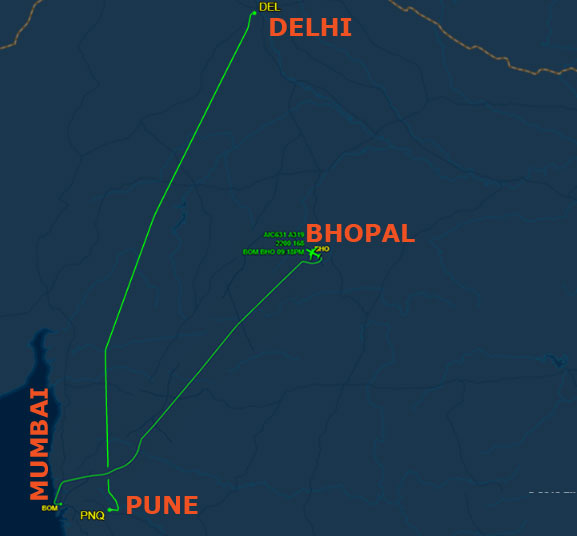
One aircraft was at 27,000ft and the other was at 27,100ft altitude. The speed of the Air India flight was 1080km/hr. The Vistara flight was covering 763 km in an hour. The lateral separation between the flights was 2.8km. The bearing of Vistara flight was 177 degrees and that of AI was 74 degrees, approx.

If we draw two lines extending the path of both the aircraft, it can be seen  that  they would cross  each other at a distance of 2km (down) from the present position of Vistara fight. To reach that point, the time  taken by Vistara would have been 9 seconds. But during those 9 seconds, AI flight would  been moved 3.9km away from its present position.
So there were no collision going to happen.

But then what about the TCAS urgent warning?  Can computers go wrong?

The computers of course were not wrong. Only that, these systems always incorporate a factor of safety in all calculations. An extra allowance will be added to all the distances and heights. And that is how it should be.

The Area Controller factor

In the sensationalized report of Times of India, this character got only a passing mention – but that was damaging enough.  According to the report, the AC was taken by surprise  ‘seeing’ the Vistara fight at level 271.  The question the AC reported to have asked the Vistara pilot – “why are you here?”-  betrays his total lack of control over his job. A person constantly monitoring the flight can’t be taken off guard like that.  So he indeed was a villain, though not the main one, in the story.

The main villain and the heroine

And about the main one, there were enough ingredients- lucky for the reporter- to spice up the  whole thing: the co-pilot was a woman; she was alone; her Commander was not anywhere near at the critical moment.  A young, in experienced, ignorant girl of a pilot left  alone to find her way out of the mess she had made was the perfect dark background for the heroine of the story.
And what a heroine it was to be !

– A mature, elegant woman in her late forties with 20 years of flying experience under her belt, the Air India commander was the perfect picture of the cool, composed superwoman who averts imminent disaster at the nick of time.

So we have the day-two story:

Near miss: How AI’s woman pilot saved lives of 261 flyers

And it will be highly inappropriate to end this note without mentioning an effort actually made by the ToI reporter to guess why there was a ‘confusion’ between the Vistara flight  and the AC.

” There may have been confusion between the ATC and Vistara cockpit — which at that time had a woman co-pilot at the controls and the captain had taken a toilet break. The AI flight had a woman commander, Captain Anupama Kohli. Maybe there was a mix-up in communication in those tense seconds like what altitude instruction is being given to which lady. This has to be seen,” said sources.”

So the assumption is that the AC got confused between the two woman voices.  It is sad that the reporter didn’t pause for a second to think about the numerous male voices an AC hears throughout the day from the cockpits of so many flights, without confusing among them.  Before writing down this silly guess, the reporter should have tried to understand a basic norm too of radio communication : Before the start of each instruction, the controller has to spell  the call-sign of the aircraft he is giving the instruction. And when the pilot replies, she/he also has to say his call-sign at the end of his words. And above all, the aircraft is constantly being  monitored visually on the radar screen, by the AC at the Area Control.

The leak

How the details of the incident found their way to the media is intriguing, to say the least.

In both the reports,  there were details that were known only to the people directly involved in the incident and to the officials of DGCA who had received reports from the parties involved – the facts that the Vistara co-pilot and Air India commander were women and the Vistara male commander was taking a toilet break during the incident are examples.

The AC , AAI and the Vistara crew  would not have leaked the info, for obvious reasons.  The remaining parties are the Air India crew and the DGCA.  Given the heroine status given to and readily accepted by its senior pilot, Air India of course is the chief suspect.  And they couldn’t have done that alone.  The other half of the story unfolded the night of 7th February aboard the Vistara flight must have been filled in by someone who had access to the report Vistara sent to the DGCA.

But why?
Why should someone from Air India and/or DGCA take the pains to give these details to the press? Not for the sake of air safety, that is obvious. If that was so, the report would have been much more accurate and the day-two story glorifying the AI commander would never have happened.

The ongoing investigation by Aircraft Accident Investigation Bureau will serve its purpose fully only if the answer to the above legitimate question too is found out.

(Jacob K Philip, a Doha based aviation analyst, is the honorary editor of Indian Aviation News Net. He can be reached at jacob@indianaviationnews.net)
Share this:
Share this page via Email Share this page via Stumble Upon Share this page via Digg this Share this page via Facebook Share this page via Twitter

Air India Express incident at Kochi airport: Blue lights could be the culprit


By Jacob K Philip

An aviation hazard, known as “Sea of Blue Effect” combined with the fatigue of the cockpit crew could be the reason of the taxiway excursion by an Air India Express flight during the wee hours of 5th September at Kochi international airport.

An analysis of the incident done with the help of aviation experts having many years of experience with Airports Authority of India and Air India excludes all possibilities, but this phenomena, which though specifically mentioned in the Aerodrome Design Manual (Part IV) released by International Civil Aviation Organization (ICAO), is rarely documented and reported in India so far.

The incident

On September 5, the Air India Express Abu Dhabi-Kochi flight 452 landed at Kochi International Airport at 2.20AM on runway 27. After landing, the aircraft exited the runway through link C2 and then turned right to go to the apron of the new terminal T3. To reach the designated apron, the aircraft was instructed to exit the taxiway using the link-taxiway F in the left, after B and E. Everything went well till the aircraft reached near the exit E.  As per the reports of the incident, the aircraft  took the left turn 90m before the actual exit F. So, instead of entering the apron, the aircraft crossed into the space between link taxiways E and F and its rear wheels got caught in the 1m wide open drain that runs parallel to the taxiway. While the wheels descended into the drain, the bottom side of the two engines of the Boeing737-800 aircraft hit the paved surface beneath. The nose-wheel assembly too damaged as the most of the weight of the aircraft got suddenly transferred  to it.

The Sea of Blue

To see how an experienced pilot could cross into an open space mistaking it for the link-taxiway, we may visualize what the pilots of the aircraft were seeing from the cockpit of the aircraft during its movement  towards exit F.

When the aircraft moved forward at a speed of 18knots, the pilots must’ve been seeing  clearly  the taxiway stretching ahead. The thick yellow line marking the centre-line of the taxiway too must’ve been visible, thanks to the edge lighting.  A little farther ahead on the left, there were four links-taxiways perpendicular to the taxiway that connect the taxiway with aprons.  These links -denoted by Roman alphabets  B, E, F and G- too had blue edge lights.

When the aircraft initiating the 90 degree turn to enter the link-taxiway, the glow of the blue lights fitted along the edges of the four parallel exit paths can together appear as a huge, rectangular illuminated surface. This optical illusion is the Sea of Blue Effect.  It occurs because blue light that travels as shorter, smaller waves gets scattered more than other colors.  The light thus scattered from the edges of the five link-taxiways spaced just 125m apart can easily overlap, hiding the open land between them. So the chances are abundant for the pilot either to totally miss the actual exit that got submerged in the ‘blue sea’ or to confuse between the exit (link-taxiway) and the area  between the link-taxiways.
And it seems Flight IX452 did commit the second mistake- it turned 90 degrees to the left through the open area between E & F links-taxiways, instead of entering the link F.

But why only this pilot?

Many cockpit crew before him too would have got confused, no doubt. Only that they all could overcome the illusion just in time.  And the reason why this pilot succumbed to the playing-of-tricks by blue lights could be the very timing of the flight. IX452 that landed at 2.20 am at Kochi airport was the same aircraft that flown from Kochi to Abu Dubai as IX419 the previous evening. IX419 that took off from Kochi at 5.20pm had landed at Abu Dhabi by 7.50 pm. Within one hour, the aircraft departed to Kochi as IX452, operated by the same crew.  That means the pilot who mistook the open land as a link taxiway was continuously flying the aircraft from 5.20pm to 2.20 am, but for a one hour gap from 7.50 to 8.50pm.

And it may also be noticed that the taxiway excursion was happened 20 minutes after the beginning of the Window of Circadian Low. (WOCL, the interval of time from 2.00am to 6.00am, is a period during which people working through night can experience maximum fatigue). The end of the flight coinciding with the WOCL is more dangerous. Seeing that the duty time is almost ended, a fatigued person’s all urges will be to do away with it as soon as possible. It was only natural for the pilot to become more impatient seeing he is almost  there- a turn and then the apron and the end of the journey. And this fatigue-triggered impatience could have made him an easy prey of the  Sea of Blue illusion.

The other possibilities

  1. Reduced visibility

It is understood that the visibility at the airport during the time was more than 800m. For an aircraft moving at 20kmph, this visibility is more than enough to see the turns & obstructions ahead.

  1. Objects on the runway

Obstacles happen to be on the runway can cause the nose wheel lose control, while going over it. But nothing of this sort was reported.

  1. Faulty nose wheel moving erratically, resulting in unintentional right turn.

This indeed is a chance, especially for this particular aircraft. On March 11th 2014, while operating as  IX-193, this VT-AYB aircraft had its nose-wheel damaged during taking off from Lucknow for Dubai. Seeing parts of nose wheel gear on the runway, the ATC called the aircraft back. But the damage was repaired soon after, and the aircraft was flying all these three years after the incident.

  1. Hydroplaning & skidding

when there is lots of rain water on runway layers of water can accumulate between the wheels of the aircraft and the runway, leading to a loss of traction and  loss of control. But the rain was not that strong Tuesday night, for this to happen. Moreover, the plane’s speed was only around 20kmph.


(Jacob K Philip, a Doha based aviation analyst, is the honorary editor of Indian Aviation News Net. He can be reached at jacob@indianaviationnews.net)
Share this:
Share this page via Email Share this page via Stumble Upon Share this page via Digg this Share this page via Facebook Share this page via Twitter